






Breakfast Event: Unlocking Switzerland’s AI Potential
The Swiss AI Action Plan
The day started with the breakfast session Unlocking Switzerland’s AI Potential: The Swiss AI Action Plan at the Cloudflare Lounge.
In their opening remarks, Franziska Barmettler, CEO of digitalswitzerland, and Alissa Starzak, VP, Deputy Chief Legal Officer and Global Head of Public Policy at Cloudflare, positioned the Swiss AI Action Plan as a central and shared priority. From Cloudflare’s perspective, AI must be inclusive and resilient, bringing together different perspectives while embedding security from the outset. As AI systems increasingly operate through agents, trust, credential management and secure inference become important for adoption at scale.
A highlight of the breakfast was the presentation of a new economic report developed by Implement Consulting Group for digitalswitzerland and Google. The findings were presented by Christine Antlanger-Winter, Country Director of Google Switzerland, Martin H. Thelle, Senior Partner at Implement Consulting Group, and Franziska Barmettler.
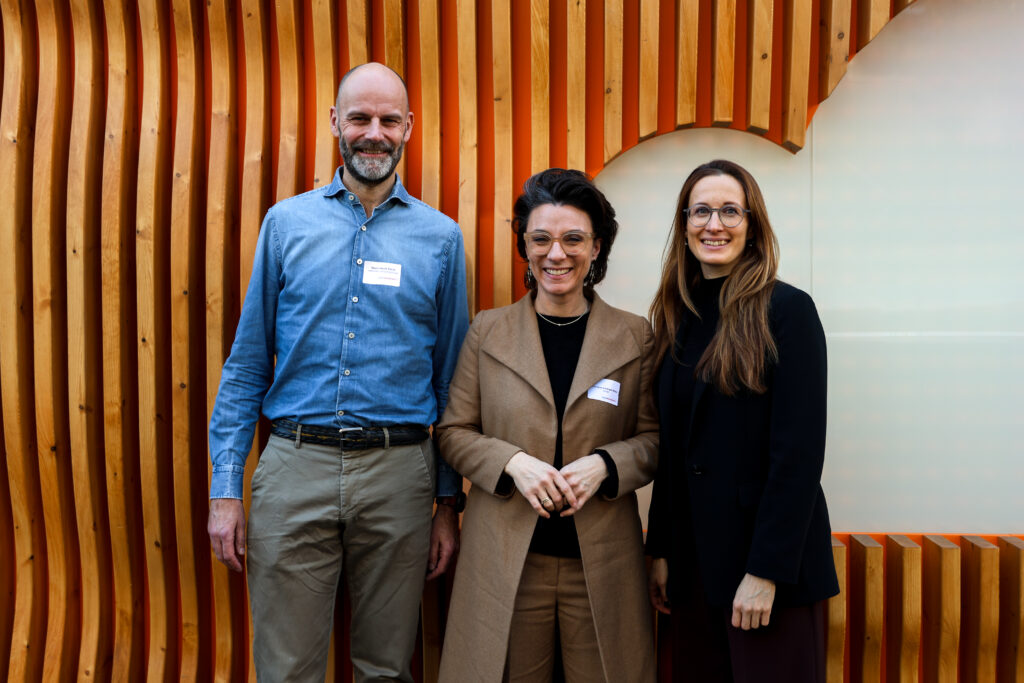
The report shows that Switzerland can unlock an annual CHF 15 billion AI innovation potential by using AI in research and development and innovation processes. AI is described not merely as a productivity tool, but as a new method of invention that can help reverse the long term decline in R&D productivity. Learn more about the study here.
Thelle expanded on the implications of the study, emphasising that the 15 billion Swiss francs innovation potential will not materialise automatically. AI-driven research is intensive and requires sophisticated infrastructure, access to high quality AI models and applications, and a clear strategic framework. He underlined that around three-quarters of future value creation is expected to emerge at the application layer, particularly through domain-specific solutions and fast-growing innovative firms.
In her assessment, Franziska Barmettler outlined how the Swiss AI Action Plan aims to address these challenges in a participatory way. The central task, she noted, is to manage risks while staying competitive and engaging the population in the journey. Both the public and private sectors are important to this process.
A contribution by Marco Huwiler, Country Managing Director of Accenture Switzerland, placed Switzerland’s approach in an international context. He contrasted the scale-driven innovation culture of the United States with Singapore’s government-led and highly efficient AI action plan, which includes AI guidelines and strong public sector literacy.
House of Switzerland Event: Geopolitics for Tech Supremacy
Policy, Practice and Partners in a Fragmented World
In the same morning, digitalswitzerland partnered with the National Cyber Security Centre Switzerland NCSC to host the expert event Geopolitics for Tech Supremacy: Policy, Practice and Partners in a Fragmented World at the House of Switzerland.
Florian Schütz, Director of the NCSC, and Thomas Holderegger, President of the National Cybersecurity Committee at digitalswitzerland, opened the session. They framed the discussion around the growing impact of geopolitical tensions on cybersecurity, technological dependencies, and digital sovereignty. They emphasised that cyber resilience has become a strategic capability for states and economies, particularly for small and open countries like Switzerland.
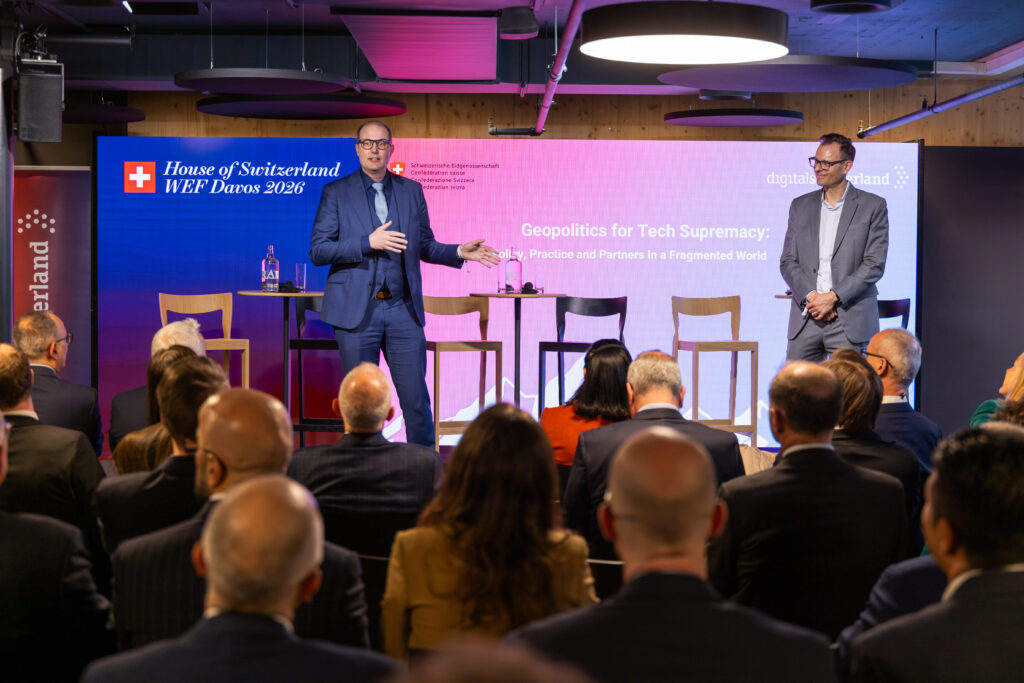
In his keynote, Gilles Carbonnier, Vice President of the International Committee of the Red Cross ICRC, highlighted the humanitarian and societal implications of cyber conflict. He stressed that digital infrastructures are increasingly part of modern conflict environments and that protecting civilians, essential services and trust in digital systems must be a priority in geopolitical decision making.
Christopher Painter, Founder of the Cyber Policy Group and former senior US cyber diplomat, followed with a global policy perspective. He underlined that technological supremacy is no longer defined by individual capabilities alone, but by alliances, norms and shared frameworks.
The subsequent high level panel discussion brought together Maya Bundt, President of the Steering Committee of the Swiss National Cyber Strategy, Casper Klynge, Vice President and Head of Government Affairs EMEA at Zscaler, Eric Nicolas from the Swiss Cybersecurity Association, and Sir Rob Wainwright, CISO at UBS and former Director of Interpol. The panel explored how geopolitical rivalry, sanctions regimes and regulatory divergence are reshaping the cyber threat landscape.
The session then moved into three moderated discussion rounds focusing on geopolitics, technological supremacy and digital sovereignty, with contributions from representatives of government, industry, academia and civil society. Across the discussions, participants highlighted the need to reduce critical dependencies, diversify technology partnerships and maintain interoperable digital ecosystems wherever possible.
Lunch Event: Global Perspectives and Switzerland’s Approach
Towards effective AI governance
The digitalswitzerland Lunch at the Waldhuus Hotel focused on Towards effective AI governance: global perspectives and Switzerland’s approach and brought together high-ranking representatives and C-level executives from government, academia and industry, and was moderated by digitalswitzerland President Andreas Meyer.
In his keynote, Alain Berset, Secretary General of the Council of Europe, underscored the need for consistent safeguards in AI governance and emphasised that democracy, human rights, and the rule of law must remain non-negotiable. He presented the Council of Europe’s Framework Convention on AI as a risk-based approach to translate shared values into practice.
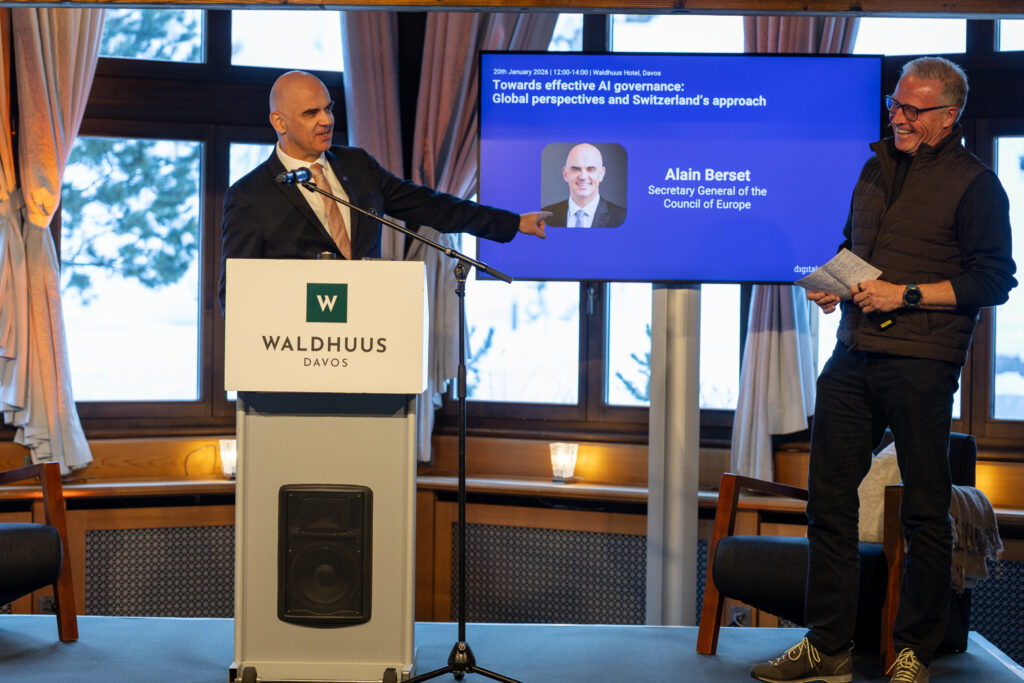
Bernard Maissen, Director of OFCOM Switzerland, outlined Switzerland’s pragmatic governance model, combining targeted legal safeguards with voluntary, sector specific codes of practice developed together with industry and science.
From an academic perspective, Professor Effy Vayena, Vice President for Knowledge Transfer and Corporate Relations and Professor at ETH Zurich, mentioned the importance of a science led and participatory approach to ensure governance is fit for purpose and grounded in real world applications.
Representing the private sector, Ladina Heimgartner, CEO of Ringier Media Switzerland, underlined the value of co-creating AI governance frameworks with regulators to ensure transparency, accountability and trust, particularly in the media sector.
An international perspective was added by Erkki Keldo, Minister of Economy and Industry of Estonia, who highlighted the need for regulatory clarity, speed and strong digital literacy in public administration.
Afternoon Event: AI Literacy and the Future of Work
The final event of the day took place at the Cognizant Chalet and focused on AI Literacy and the Future of Work. The session was moderated by Chris Luebkeman, Head of Strategic Foresight at ETH Zurich, who guided the discussion toward practical inputs.
Opening the session, Franziska Barmettler highlighted a growing perception gap between leadership and the workforce. While many leaders report that they have taken decisive steps on AI, only a small share of employees say their daily work has meaningfully changed, making engagement, communication and practical upskilling essential.
The discussion was framed by three short firestarter inputs. Kian Katanforoosh, CEO of Workera and Stanford AI Adjunct Lecturer, outlined how AI is reshaping learning and skill development, moving away from rigid qualifications toward flexible micro credentials that better reflect real world capabilities and evolving job requirements. Adriana González Delshorts, Vice President DACH at EF Corporate Learning, described AI as a fundamental pedagogical shift, enabling more personalised and inclusive learning paths across age groups and professional backgrounds. Babak Hodjat, Chief AI Officer at Cognizant, focused on overcoming systemic resistance to AI by involving people directly through hands-on experimentation and practical use cases.
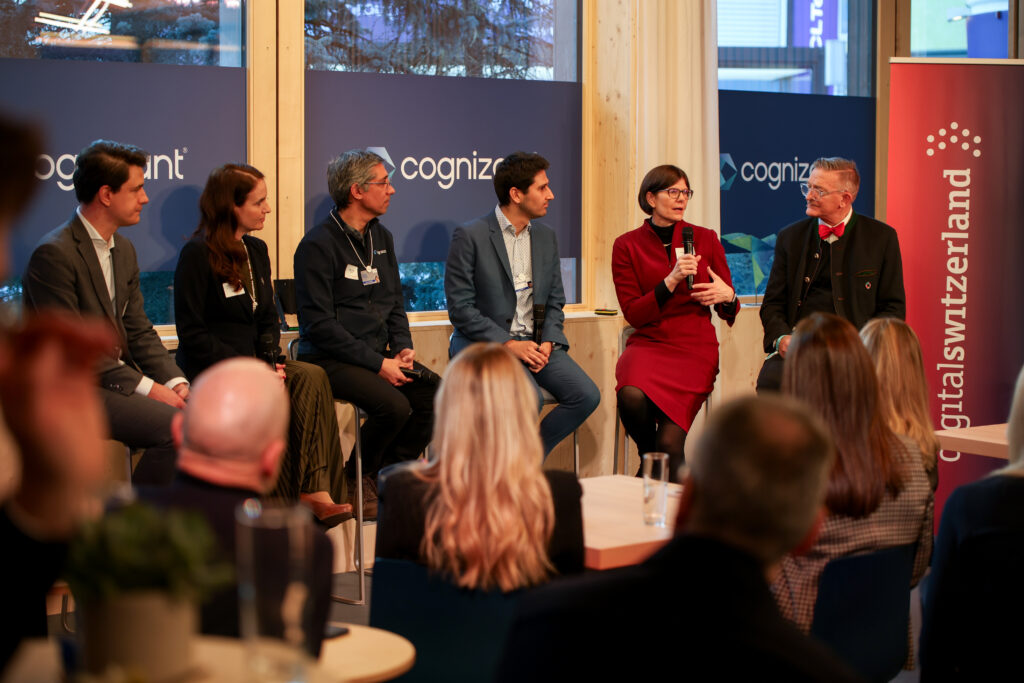
In the panel discussion, Catrin Hinkel, CEO of Microsoft Switzerland, shared Microsoft’s commitment to broad AI literacy and responsible adoption, while Rafael Wampfler, Senior Researcher at ETH Zurich, added insights on how different audiences engage differently with AI tools and why literacy efforts must be tailored.
AI adoption succeeds when people are empowered and included. AI literacy must therefore go beyond technical skills to include critical thinking, ethical awareness and responsible use, ensuring that the workforce becomes an active participant in the AI transformation rather than a passive observer.
Thank You and See You Next Year
The four events at Davos 2026 demonstrated that innovation, infrastructure, governance and skills are inseparable elements of Switzerland’s AI journey. Turning AI potential into long term public value will require coordinated action across all these dimensions.
digitalswitzerland would like to thank all speakers, partners and participants for their valuable contributions in Davos. Your engagement was instrumental in fostering thoughtful dialogue on AI and digital transformation. We look forward to continuing this journey together and to welcoming you back to Davos next year.

