We might not have all the answers but we welcome all questions. Please reach out to us with media inquiries, questions about membership or non-political partnership, ideas or requests. We look forward to hearing from you in any of the official Swiss languages or English.
Become a Member or non-political partner.
Do you have any further questions around becoming a digitalswitzerland member or a non-political partner of our foundation? We are happy to have a conversation with you about our offerings.
Newsletter
Get the latest digital thinking direct to your inbox. Join more than 14,000 fellow digital enthusiasts for our regular round-up of the latest news, project updates and ideas to inspire.
Download document
After subscribing to our newsletter you can download the document.
digitalswitzerland WEF breakfast: Discussing digital transformation with Alexander Karp and Alain Berset
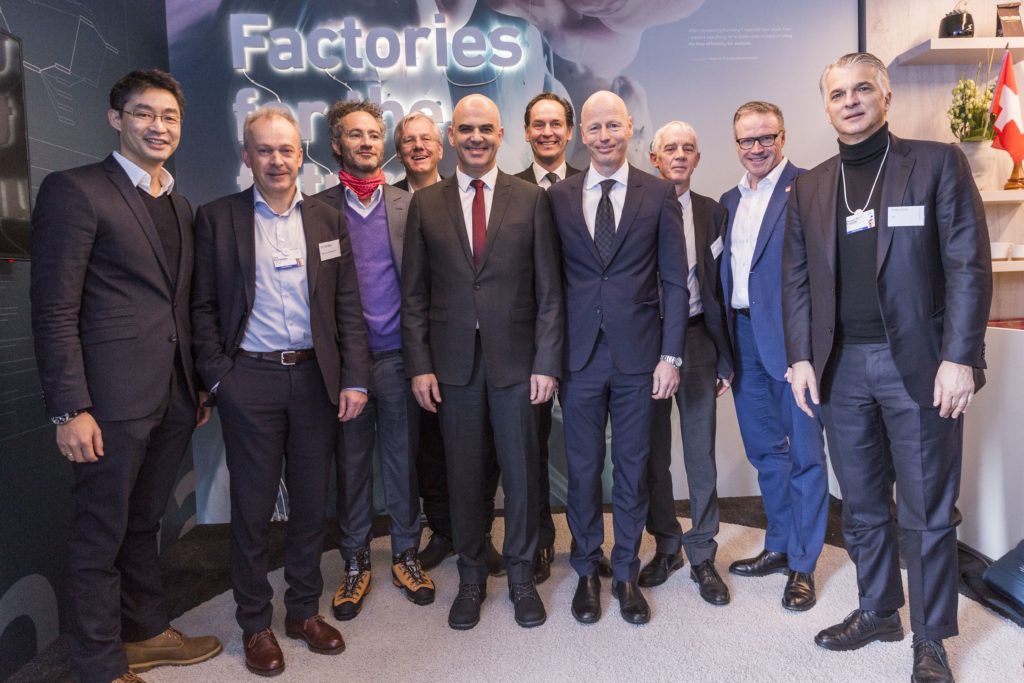
The early bird catches the worm! This saying was particularly true on Wednesday, 24 January 2018. digitalswitzerland organized a high-level panel discussion and breakfast on the topic: «Switzerland, the world’s most innovative country at the intersection of technological innovation and social acceptance.» At the panel in the Palantir Pavillon in Davos discussed early risers Alain Berset, President of the Swiss Confederation, Alexander Karp, CEO and co-founder of Palantir, Philipp Rösler, former managing director of WEF and Marc Walder, CEO of Ringier and initiator of digitalswitzerland. The digitalswitzerland-breakfast was attended by many C-Level members of digitalswitzerland.
From left to right: Philipp Rösler (Former MD WEF), Urs Schäppi (CEO Swisscom), Alexander Karp (Co-Founder and CEO Palantir), Christoph Franz (Chairman Roche), Alain Berset (Federal President), Patrick Warnking (CEO Google), Marc Walder (CEO Ringier and Initiator digitalswitzerland), Martin Vetterli (President EPFL), Andreas Meyer (CEO SBB), Sergio Ermotti (CEO UBS) Photo Credit: Schweizer Illustrierte
The world’s most innovative country between technological innovation and social acceptance
After a short introduction of Alexander Karp, where he talked about the journey of Palantir technologies and hippie times, he addressed the issue of data. According to Karp the big challenge is the question of who controls data ownership. What happens with our data should not be decided in Silicon Valley, he believes. Instead the state should make the final decision regarding data ownership, privacy and ethical questions. Karp: «Digitization raises moral, ethical and economic questions that can only be answered by the state.»
By loading the tweet, you agree to Twitter’s privacy policy. Learn more
Federal President Alain Berset admitted that he himself does not know where the digital journey will lead to and which might be the consequences for a country like Switzerland, but for sure that we are dealing with fundamental questions in every area of life and work. Berset agreed with Karp: «We need some kind of ethics in digital transformation.» He further sees a necessity for defining a framework, which is dealing with that kind of questions.
Defining the Swiss digital identity
Another topic discussed, concerned the importance of a digital identity in Switzerland. Marc Walder thinks that companies have the responsibility to be transparent and open when it comes down to personal data. It is a trust issue: «People need to know what happens with their data.» He further pointed out that if we look at the ten most valuable tech companies, we see that there are zero tech companies in Europe. «For Switzerland it is about being an innovation driver and not being a copycat nation.» In his words, Switzerland is «feeling very little pain» and needs to understand the importance of ‘being digital.’
Moving Switzerland forward means adjusting the Swiss educational system
One other thing that makes our country a more ‘digital Switzerland’ is education. Marc Walder told the audience that his daughter is still learning the exact same subjects as he himself did, 45 years ago. «She goes to school as there were no digital skills needed.» Walder proposes that mandatory coding classes could be a way for children to get ready for a a more and more digitized world. Alain Berset added to this statement that children should especially acquire social competences to be able to understand what the digital transformation means in concrete terms. Geneva councilor Pierre Maudet, who was present in the audience, proposed that children could for example learn how to pitch. Getting to the heart of a big idea in short sentences is according to him a skill that is useful in every kind of learning or work environment.
Food for thought
The Swiss business leaders who gathered early in the morning not only left well fed, but also with new food for thought. How can Switzerland stay on top in terms of digital innovation and become an innovation driver, while dealing with sensitive issues such as data privacy? What role will have the private, but also the public sector in the digital transformation? These questions will continue to be of concern for thinkers, transformers and everyone on an individual level.
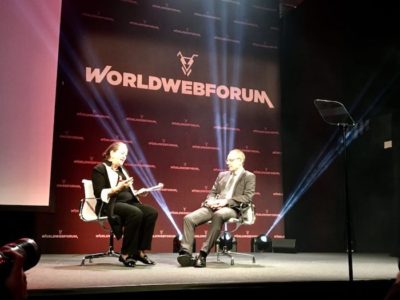
Are nation states outdated and will technology take over our world? Will we be all Google citizens or Amazon-ians one day? Business leaders, techies and the brightest minds from Silicon Valley and Europe gathered on 18 January 2018 to discuss this year’s WorldWebForum provocative topic «end of nation». A vibrant and enthusiastic conference crowd celebrated disruptive technologies and business models.
Federal Councilor Schneider-Ammann: We need the nation-state more than ever
Right at the beginning, Swiss Federal Councillor Johann Schneider-Ammann contradicted the conference’s slogan with a plea for a strong state. He underlined opportunities of the new technological possibilities and at the same time pointed out that with the fast-changing environment, increasing complexity and new technologies, lifelong learning is becoming a necessity. In the past, young people learned in school almost everything they needed for their later career. Today, the learning process is a continuous one and what was relevant two years ago, might be already outdated today. With digitization and automatization comes the fear of being replaced by robots. As Federal Councilor Schneider-Ammann admitted, he himself would not want to live on a planet with an 85% unemployment rate. He closed his statement by saying that as in every revolution, there might be losers. Therefore, for him, states are not outdated, but needed more than ever.
Mark Thompson: Make disruption paranoia productive!
Mark Thompson, bestseller author and Senior Executive Coach, who worked amongst others for Steve Jobs and Richard Branson, asked how to stay fit in a digital age. In his keynote, he talked about “Productive Paranoia”. This is not a paranoia based on fear or hiding from reality – instead it is the willingness to look at competitors and what they are doing right. Secondly, Thompson pointed out that it is not safe to play it safe anymore, but to take risks and develop a culture of failure. In Switzerland, there is room for improvement and risk-taking. What still is missing is a Swiss culture of failure.
By loading the tweet, you agree to Twitter’s privacy policy. Learn more
Carissa Carter and Nancy Pfund advocate for more responsibility in business
Carissa Carter, director teaching and learning from Stanford University, was talking about empathy and responsibility and how to solve problems with design thinking. One of the Tesla’s early investors, Nancy Pfund, spoke about responsibility and impact investment. According to her, in the past, many people believed that it would be enough to force change in a society by donating money to political parties and politicians. After the Trump election, many more people recognized that this does not suffice anymore and started committing themselves to a positive change in society.
By loading the tweet, you agree to Twitter’s privacy policy. Learn more
Artificial intelligence adds a new dimension to human’s creativity space
Lino Guzzella, President of ETH Zurich and steering committee member of digitalswitzerland, gave a short insight into the challenges that a world leading university with a public mandate is facing in the digital era. Among others, he talked about Artificial Intelligence and told the public that he was asked once, whether an AI would have discovered Newton’s Law of Gravitation. His answer to that is simple: ‘If Newton had AI, he would have done that simply much faster and earlier. Artificial Intelligence is a fantastic development with a huge potential that will be just an additional tool to the capacity of humans. Guzzella sees this as a new dimension of human’s creativity space and is convinced that with bringing artificial and natural intelligence together, we will have a better chance to cope with the big challenges.
Save the date! The second Digital Day will take place on 25 October 2018
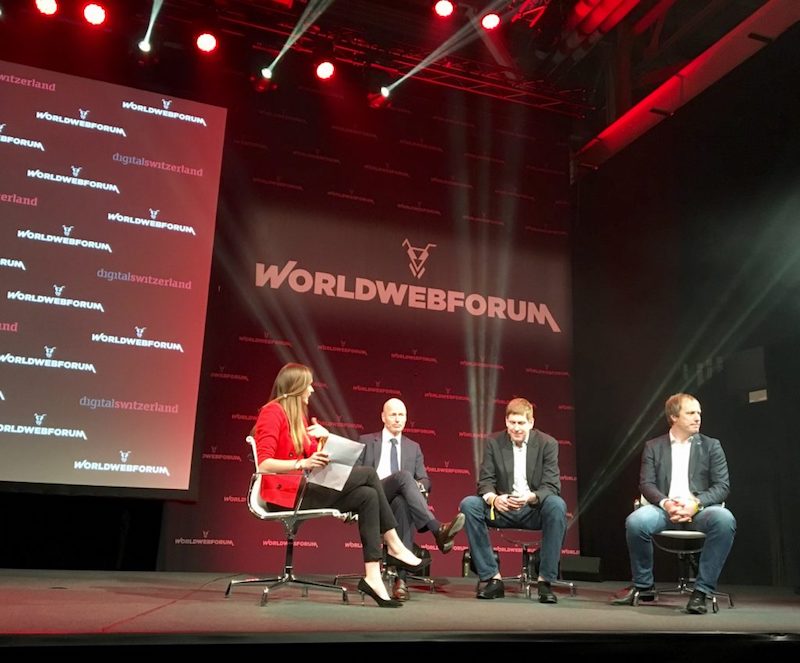
digitalswitzerland founder and CEO Ringier, Marc Walder, talked with Hugh Forrest, director South by Southwest (SXSW) Interactive Festival and Taavi Kotka, former Chief Information Officer for the Estonian Government, about global innovation hubs. The tiny post-soviet country Estonia has become a leading pioneer in digital governance. For Marc Walder this is the perfect example of how the digital change could be embraced. The panelists further talked about the need to feel the urgency: when the pain is enough, you need to change. Switzerland needs to get this sense of urgency to move forward.
During the panel, Marc Walder announced the date for the second Swiss Digital Day, which will take place on Thursday, 25th October 2018. So, mark this date in your agenda! We are committed to making this unique event even bigger and involve all of the Swiss regions and especially the public. Thus, we would like to hear what you are interested in seeing and experiencing during the Digital Day 2018. What are your questions on digitization? Your opinion is important and valuable to us. If you have any feedback, please write us here.
By loading the tweet, you agree to Twitter’s privacy policy. Learn more
Compassionate capitalism: There is more to it than just making profit
Suzanne Di Bianca, Corporate Relations and Chief Philanthropy Officer at Salesforce, inspired with her talk to sign up for the 1:1:1 Pledge. Suzanne pioneered the 1:1:1 Pledge model of integrated corporate philanthropy, which dedicates 1% of Salesforce’s equity, employee time or product back into the community. For Di Bianca, sustainability in business is a must. It is not only about taking and taking from customers, but to give something back. The future belongs to the value-driven companies.
‘Technology is helping to enforce boundaries and at the same time makes them less strong’
Professor David J. Teece from Berkeley University elaborated on the conference’s prediction, ‘the end of nation.’ His conclusion to the question is that if we look back in history, we can assert that companies are way more fragile than nations. In general, the trend in international business has become that more and more companies are stateless and competition between states have increased. There is more complexity, competition and a deep uncertainty. Teece advise to handle uncertainty: what really matters is instinct and the need to align agility and strategy.
It is not the end of nations. But state authorities are challenged in the new digital era
As the topic of the conference implied and what is observable on a global scale, tech companies are becoming powerful, even more powerful than certain states. Technology is disrupting business, politics and challenging state authorities. The question is how to realize the full potential of digitization and how to cushion its negative outcomes. To solve those big questions and problems, innovative and smart thinkers are needed and still: the nation state. With all these promising progresses and exciting perspectives ahead, we should not forget that we are still living in a physical and not digital world and in the end, what really counts is how we can use technologies to the advantages of not only a few, but to include everyone.
Newsletter
Get the latest digital thinking direct to your inbox. Join more than 14,000 fellow digital enthusiasts for our regular round-up of the latest news, project updates and ideas to inspire.